


Overview
Wallet of Satoshi represents one of the most user-friendly entry points into Bitcoin's Lightning Network. This custodial mobile wallet strips away the technical complexity typically associated with Lightning payments, offering instant transactions with zero configuration required. While experienced bitcoiners may balk at its custodial nature, Wallet of Satoshi has become the go-to recommendation for newcomers seeking their first Lightning experience—and for good reason.
The app delivers on a simple promise: make Lightning payments as easy as using Venmo or Cash App, but with Bitcoin's superior monetary properties and global reach.
Why It Exists
The Lightning Network, despite being Bitcoin's most promising scaling solution, has historically suffered from a significant UX problem. Self-custodial Lightning wallets require users to manage channels, maintain liquidity, stay online for payments, and navigate technical concepts like inbound capacity and routing. For the average person wanting to send or receive small Bitcoin payments, these barriers prove insurmountable.
Wallet of Satoshi emerged to solve this onboarding crisis. By abstracting away Lightning's complexity through a custodial model, it created a bridge between traditional payment apps and the Bitcoin ecosystem. The wallet tackles three critical pain points: eliminating channel management headaches, providing instant liquidity for both sending and receiving, and offering a zero-learning-curve interface that works immediately upon installation.
What It Does
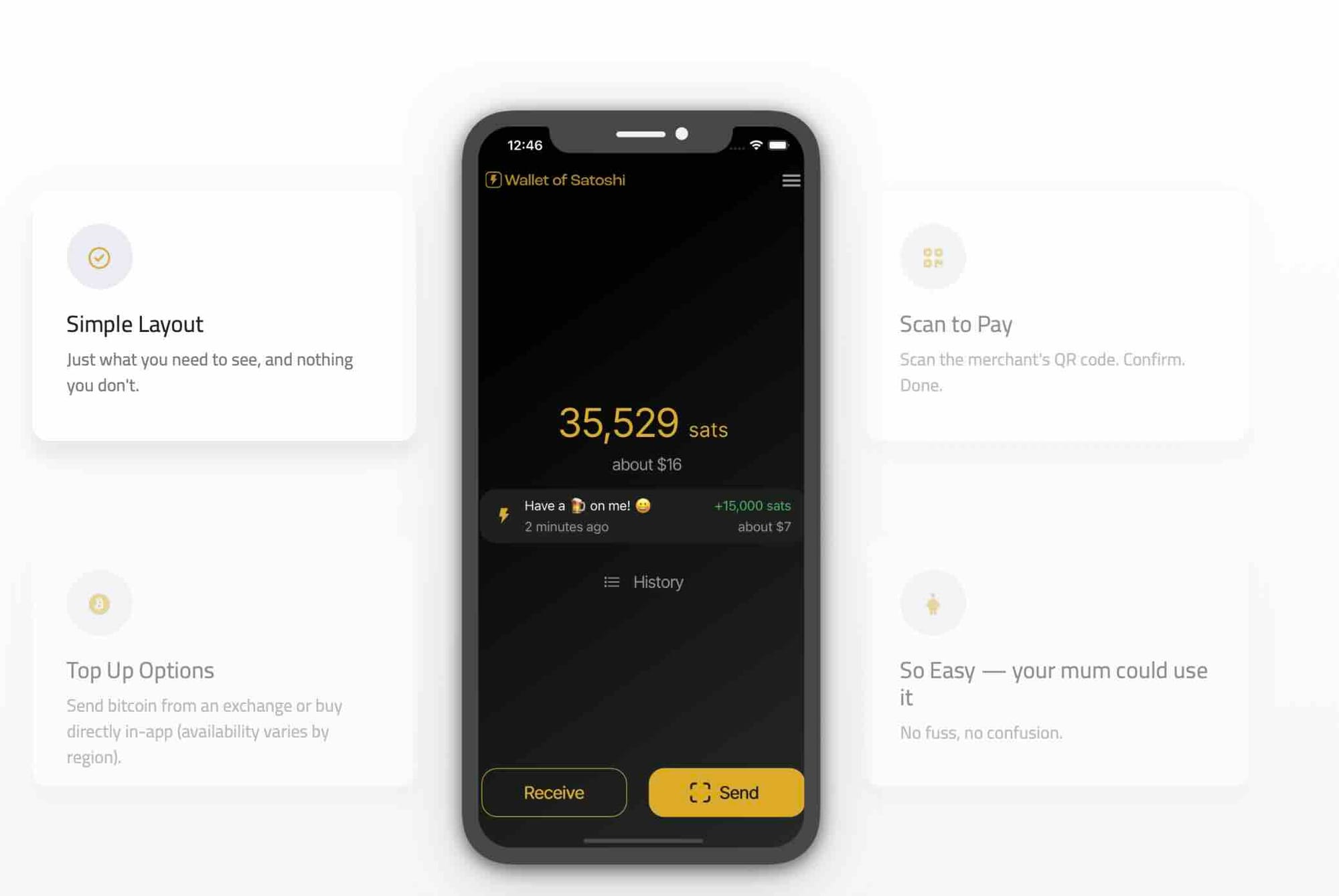
Wallet of Satoshi functions as a custodial Lightning wallet with seamless on-chain capabilities. Here's what that means in practice:
- Lightning Payments: The core functionality centers on Lightning Network transactions. Users can send and receive payments instantly with negligible fees—often just a few satoshis regardless of amount. The wallet handles all routing automatically, making payments feel instantaneous.
- Unified Balance: Your balance works seamlessly across both Lightning and on-chain Bitcoin. There's no need to manually manage funds between layers or understand the technical distinctions. The wallet automatically handles these conversions behind the scenes.
- QR Code Interface: Both sending and receiving rely on simple QR code scanning. Generate a Lightning invoice to receive payment, or scan someone else's invoice to send. The app supports both BOLT11 invoices and Lightning addresses.
- Lightning Address: Each user receives a Lightning address (username@walletofsatoshi.com), making it easy to receive payments without generating new invoices. This email-like format has become an industry standard for recurring or spontaneous payments.
- LNURL Support: The wallet implements LNURL protocols, enabling advanced features like withdrawals from Lightning-enabled services and streamlined payment flows.
- Currency Display Options: While balances show in satoshis by default, users can toggle between sats and various fiat currencies for easier mental accounting.
- Transaction History: A straightforward ledger shows all incoming and outgoing payments with timestamps and amounts.
What Wallet of Satoshi deliberately doesn't do is equally important: there's no channel management, no force closes, no liquidity concerns, no backup phrases for Lightning funds, and no technical configuration of any kind.
Who It's For
Wallet of Satoshi serves several distinct audiences exceptionally well:
✅ Bitcoin Beginners: Anyone taking their first steps into Bitcoin will find this wallet's simplicity reassuring. You can download it, receive your first satoshis, and make a payment within minutes—no tutorials required.
✅ Lightning Curious: Existing bitcoiners who hold coins on-chain but haven't explored Lightning yet will appreciate the zero-friction introduction. It's perfect for testing Lightning's capabilities without committing to channel management.
✅ Casual Transactors: People who want to send or receive small amounts regularly—splitting dinner bills, tipping content creators, making micropayments—benefit from the app's speed and low overhead.
✅ Travelers and Digital Nomads: Those moving between countries appreciate Lightning's borderless nature and Wallet of Satoshi's reliable global functionality (where legally available).
✅ Content Creators: Podcasters using Value4Value, streamers accepting tips, or creators on Lightning-enabled platforms find the Lightning address feature particularly useful for receiving payments.
✅ Event Participants: At Bitcoin conferences and meetups, Wallet of Satoshi has become the de facto standard for peer-to-peer transactions due to its reliability and universal recognition.
Who It's Not For
Despite its strengths, Wallet of Satoshi isn't suitable for everyone:
🚫 Bitcoin Maximalists Seeking Sovereignty: If "not your keys, not your coins" is your mantra, a custodial solution fundamentally contradicts your principles. Self-custodial alternatives exist for those prioritizing absolute control.
🚫 Large Value Storage: Wallet of Satoshi explicitly warns against using it as a savings vehicle. It's designed for spending money, not storing significant wealth. The custodial model introduces counterparty risk inappropriate for large holdings.
🚫 Privacy Advocates: The wallet collects more information than self-custodial options, and as a centralized service, it can see all your transaction activity. Those prioritizing maximum privacy should look elsewhere.
🚫 US Residents: Due to regulatory considerations, Wallet of Satoshi ceased US operations in 2024. American users must seek alternatives.
🚫 Technical Learners: If your goal is to deeply understand Lightning's mechanics and manage your own infrastructure, Wallet of Satoshi's abstraction works against you. You'll learn nothing about channels, routing, or network topology.
🚫 Professional Merchants: Businesses requiring invoicing features, accounting integrations, or regulatory compliance tools need more robust solutions.
Strengths
Unmatched Simplicity: The wallet achieves something rare in Bitcoin—genuine simplicity without feeling dumbed down. The interface presents exactly what users need and nothing they don't.
Reliability: Wallet of Satoshi consistently works. Payments succeed, the app doesn't crash, and edge cases are handled gracefully. This reliability has made it a trusted tool even among technically sophisticated users who maintain it as a "burner wallet" for small transactions.
Instant Onboarding: From download to first payment takes under two minutes. There's no account creation, no identity verification (for basic use), no seed phrase ceremony for Lightning funds—just open and go.
Excellent Receiving Experience: Unlike self-custodial Lightning wallets that require inbound liquidity, Wallet of Satoshi can receive payments of any size immediately. This removes a major pain point for newcomers.
Zero Configuration: Users never encounter concepts like channel capacity, routing fees, or network topology. The wallet handles all technical details invisibly.
Cross-Platform Consistency: Available on both iOS and Android with feature parity and consistent UX across platforms.
Active Development: The team regularly updates the app with improvements and bug fixes, demonstrating ongoing commitment.
Community Trust: Despite being custodial, Wallet of Satoshi has operated for years without major incidents, building substantial community trust.
Limitations
Custodial Risk: The fundamental limitation remains custodial control. Wallet of Satoshi holds the private keys to your funds. While the team has proven trustworthy, you're accepting counterparty risk—they could freeze accounts, experience a hack, or face regulatory action.
Geographic Restrictions: The 2024 withdrawal from the US market demonstrates how custodial services face regulatory pressures. Users in certain jurisdictions may lose access with limited notice.
Privacy Trade-offs: The wallet can correlate all your payment activity, knows your IP address, and collects usage data. While they claim not to sell this information, the data exists and could be compelled by authorities.
Limited Advanced Features: Power users seeking features like multi-signature support, hardware wallet integration, custom routing, or submarine swaps won't find them here.
No Recovery for Lightning Funds: If Wallet of Satoshi disappears, your Lightning balance disappears with it. The on-chain funds can be recovered via seed phrase, but Lightning channels are custodial.
Transaction Limits: While suitable for everyday spending, the wallet imposes practical limits that make it inappropriate for large-value transactions.
Dependency Risk: Users become reliant on a single company's continued operation and goodwill. Service interruption or shutdown would require immediate migration.
KYC Concerns: While basic usage requires no identity verification, certain thresholds or activities might trigger KYC requirements, varying by jurisdiction.
Comparison
vs. Phoenix Wallet: Phoenix offers a self-custodial alternative with automated channel management. It's more complex initially but provides true ownership of funds. Choose Phoenix if sovereignty matters more than simplicity; choose Wallet of Satoshi if you prioritize ease of use and don't plan to hold significant amounts.
vs. Breez Wallet: Another self-custodial option with good UX, Breez requires more technical understanding than Wallet of Satoshi but less than traditional Lightning implementations. It's the middle ground for users graduating from custodial solutions.
vs. Muun Wallet: Muun provides self-custody and unified on-chain/Lightning functionality but with higher fees due to its unique architecture. Better for users who prioritize self-custody and don't make frequent Lightning transactions.
vs. Cash App: Cash App offers similar simplicity for Bitcoin but lacks Lightning support and requires identity verification. Wallet of Satoshi wins for speed, fees, and privacy, while Cash App provides fiat integration and broader mainstream acceptance.
vs. Strike: Strike focuses on fiat-to-Bitcoin payments with Lightning rails underneath. It offers better fiat integration but requires KYC. Wallet of Satoshi is more Bitcoin-native and private.
vs. BlueWallet (custodial mode): BlueWallet offers both custodial and self-custodial modes but with a more technical interface. Wallet of Satoshi edges it out for pure simplicity in custodial use.
The competitive positioning is clear: Wallet of Satoshi occupies the "simplest possible Lightning experience" niche. Everything else either requires more technical knowledge or provides less seamless Lightning functionality.
Role in the Bitcoin Stack
Wallet of Satoshi serves as a critical bridge in Bitcoin's infrastructure. Within the broader ecosystem, it functions as:
Lightning On-Ramp: For many users, this wallet provides their first exposure to Lightning's capabilities, demonstrating what Bitcoin payments can become. This educational role extends beyond the app itself, creating informed users who may graduate to more advanced tools.
Spending Layer: In a mature Bitcoin economy, users might maintain cold storage for savings, a self-custodial Lightning wallet for regular payments, and Wallet of Satoshi for petty cash and experimental transactions. It fills the "hot pocket money" role.
Merchant Gateway: Small merchants often accept Lightning payments through Wallet of Satoshi due to its reliability and zero technical overhead. It serves as interim infrastructure while more robust merchant solutions develop.
Network Liquidity: As a large Lightning node operator, Wallet of Satoshi contributes significant liquidity to the Lightning Network, enabling better routing for all users.
Standards Ambassador: The wallet's implementation of Lightning addresses and LNURL protocols helps establish and popularize these standards across the ecosystem.
Custody Spectrum: Bitcoin's custody solutions exist on a spectrum from full self-sovereignty (hardware wallets, multisig) to fully custodial (exchanges). Wallet of Satoshi occupies the "convenient custody" position—custodial but specialized for payments rather than storage.
Pricing & Access
Wallet of Satoshi operates on a straightforward free model:
Download: Free on iOS App Store and Android Google Play Store (except in restricted jurisdictions like the US).
Account Creation: No fees, no minimum balance, no subscription costs.
Transaction Fees:
- Lightning payments incur minimal routing fees, typically 0-3 satoshis regardless of amount
- On-chain transactions use standard Bitcoin network fees
- No additional markup or service fees charged by the wallet
Currency Support: Bitcoin only—this is not a multi-cryptocurrency wallet.
Access Requirements:
- Smartphone (iOS or Android)
- No identity verification for basic use
- Available globally except in restricted jurisdictions
The economic model relies on their Lightning node operations rather than direct user fees, allowing them to offer the service free while maintaining infrastructure through routing fee income.
Editorial Verdict
Wallet of Satoshi excels at exactly what it attempts: making Lightning payments accessible to everyone. For newcomers to Bitcoin, travelers needing fast international payments, or anyone wanting to experience Lightning without technical complexity, it's arguably the best option available today.
The wallet's custodial nature isn't a flaw—it's an intentional design decision that enables its simplicity. The question isn't whether custodial solutions are "bad" in absolute terms, but whether this particular custodial solution serves its intended purpose well. By that measure, Wallet of Satoshi succeeds brilliantly.
However, users must understand what they're accepting. This is spending money infrastructure, not a savings vehicle. It's a tool for experiencing Lightning's potential, not for storing significant wealth. Used appropriately—as a hot wallet for small amounts you're comfortable risking—it becomes an invaluable part of your Bitcoin toolkit.
The geographic restrictions, particularly the US withdrawal, remind us that centralized services face pressures self-custodial solutions don't. But for many users, especially those just beginning their Bitcoin journey, these trade-offs are worthwhile.
Recommended for: Bitcoin newcomers, casual Lightning users, travelers, content creators receiving tips, and anyone needing reliable small-value transactions.
Not recommended for: Privacy maximalists, sovereignty purists, large-value storage, US residents, or those wanting to learn Lightning's technical details.
Overall Assessment: An excellent gateway to Lightning that achieves its focused mission exceptionally well. Essential for beginners, useful for veterans, and a net positive for Bitcoin adoption despite its inherent custodial compromises.
Disclosure
This review was written independently without sponsorship from Wallet of Satoshi or any competing services. The analysis reflects hands-on experience with the wallet and assessment of its role within the broader Bitcoin ecosystem. Users should conduct their own research and consider their individual needs, risk tolerance, and jurisdictional constraints before choosing any Bitcoin wallet solution.
As with all custodial services, remember: not your keys, not your coins. Use Wallet of Satoshi appropriately—as a convenient tool for small transactions, not as a substitute for proper self-custodial storage of significant Bitcoin holdings.
