


Bitcoin mining has quietly entered a new phase. While hash rate continues to grow and industrial players dominate headlines, a parallel movement is reshaping mining infrastructure from the inside: protocol-level decentralization.
DMND positions itself precisely at this junction.
Built around Stratum V2, DMND is not just another mining pool competing on fees or payout frequency. It is an attempt to rethink how mining pools should function in a Bitcoin ecosystem increasingly concerned with censorship resistance, miner sovereignty, and protocol integrity.
This review explores what DMND actually is, how it works, and—most importantly who it is for.
What Is DMND?

DMND is a Bitcoin mining pool based on Stratum V2, the next-generation mining protocol designed to improve security, efficiency, and decentralization compared to legacy Stratum V1 pools.
At its core, DMND focuses on:
- Giving miners more control over block construction
- Reducing centralized decision-making at the pool level
- Aligning economic incentives through a transparent reward mechanism called SLICE
DMND is not a general-purpose pool optimized for absolute simplicity. It is an infrastructure-first project, aimed at miners who care about long-term Bitcoin resilience, not just short-term payouts.
Why Stratum V2 Matters
To understand DMND, it is essential to understand Stratum V2.
Traditional mining pools using Stratum V1:
- Control block templates
- Decide which transactions enter blocks
- Create central points of censorship and regulatory pressure
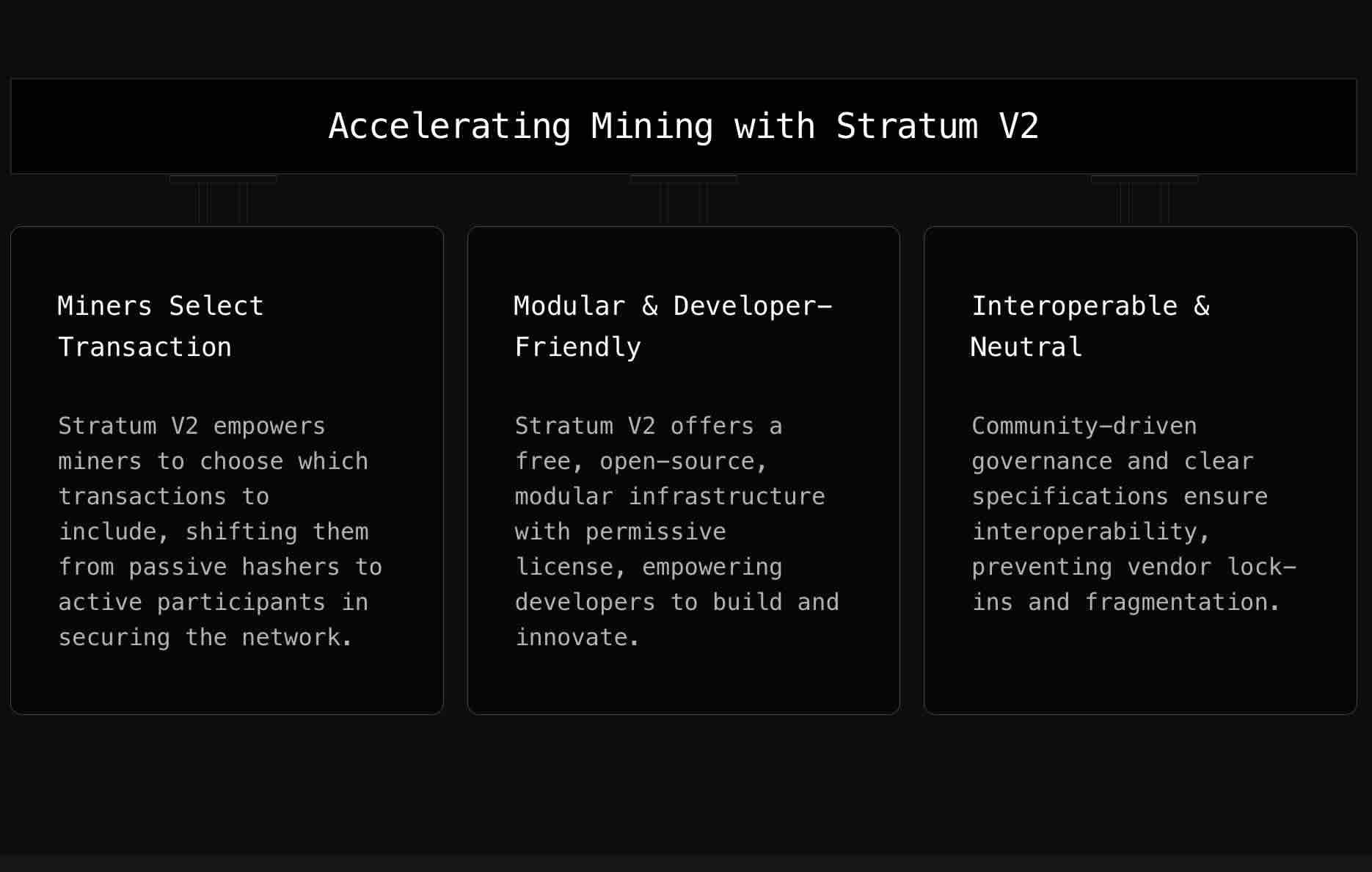
Stratum V2 changes this architecture by enabling:
- Job Negotiation: miners can construct their own block templates
- Encrypted communication: protection against hash rate hijacking
- Better efficiency: reduced overhead and more precise work distribution
DMND fully embraces this model, positioning miners not as passive hash contributors, but as active participants in block creation.
DMND’s SLICE Reward System
One of DMND’s defining characteristics is its SLICE payout mechanism.
Rather than relying on opaque or overly complex reward schemes, SLICE is designed to:
- Distribute rewards proportionally and transparently
- Align incentives between small and large miners
- Reduce strategic behavior that can disadvantage independent operators
The system emphasizes fairness over optimization tricks, which makes DMND particularly attractive to miners who value predictability and long-term alignment over aggressive variance smoothing.
Who Is DMND For?
DMND is not designed for everyone—and that is a strength, not a weakness.
Best suited for:
- Independent miners who want more autonomy
- Home and semi-professional setups using modern firmware
- Operators aligned with Bitcoin’s decentralization ethos
- Technically competent miners comfortable with Stratum V2 tooling
Less suited for:
- Absolute beginners seeking plug-and-play simplicity
- Miners optimizing exclusively for lowest fees or fastest payouts
- Operators unwilling to adjust firmware or pool configurations
DMND rewards intentional miners, not passive participants.
Transparency, Governance, and Philosophy
DMND distinguishes itself through a clear ideological stance:
- Mining should not centralize block policy decisions
- Pools should serve miners, not control them
- Infrastructure matters as much as hash rate
This philosophy is reflected in:
- Clear documentation
- Explicit support for Stratum V2
- A refusal to oversimplify trade-offs in favor of marketing
In an environment where many pools quietly converge toward centralization for efficiency, DMND deliberately chooses the harder path.
Risks and Trade-Offs
A serious review must also address limitations.
- Smaller pool size can mean higher variance compared to mega-pools
- Stratum V2 adoption still requires compatible hardware and firmware
- Not optimized for maximum short-term yield in all scenarios
DMND is a strategic choice, not a purely financial one. Miners choosing DMND are implicitly betting on the value of decentralization over marginal gains.
DMND vs Traditional Pools
| Aspect | Traditional Pools | DMND |
|---|---|---|
| Block template control | Pool | Miner (Stratum V2) |
| Communication security | Limited | Encrypted |
| Incentive transparency | Variable | High |
| Philosophy | Efficiency-first | Sovereignty-first |
| Target miner | Mass market | Conscious operators |
Final Verdict
DMND is not just a mining pool, it is infrastructure with intent.
For miners who believe Bitcoin’s security depends not only on hash rate, but on how that hash rate is coordinated, DMND represents a compelling alternative to dominant centralized pools.
It will not replace large industrial pools overnight. It is not designed to.
Instead, DMND quietly strengthens Bitcoin where it matters most: at the protocol edge, where incentives and power distribution are defined.
For miners who see themselves as builders ( not just operators ) DMND deserves serious consideration.
Disclaimer
This article is for informational purposes only and does not constitute financial or investment advice. Some links may be affiliate links; this does not affect the objectivity of the review or increase costs for the reader. Miners should always conduct their own due diligence before choosing a mining pool.
