


What is Cake Wallet?
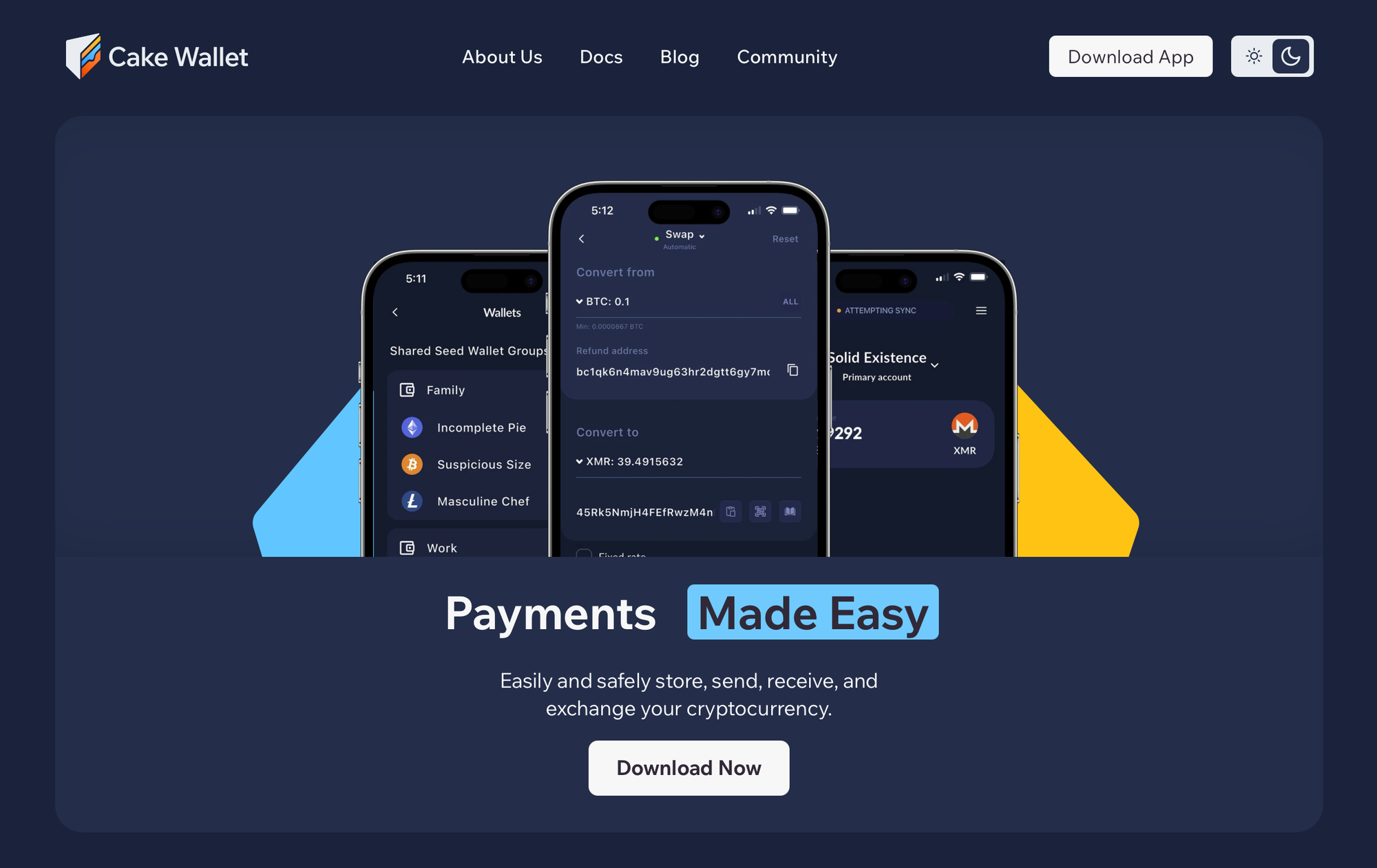
Cake Wallet is an open-source, non-custodial cryptocurrency wallet that's been quietly revolutionizing how people think about digital privacy since 2018. Founded by Vikrant Sharma with a mission to expand access to financial privacy for everyone, it started as the first Monero wallet for iOS Cake Wallet, and has since evolved into a comprehensive multi-currency wallet supporting Bitcoin, Ethereum, Litecoin, Solana, and over a dozen other cryptocurrencies.
But here's what sets it apart from the sea of generic crypto wallets: Cake Wallet isn't trying to be everything to everyone. It's laser-focused on privacy, self-custody, and making complex privacy technologies accessible to regular people—not just hardcore cypherpunks and developers.
Who Created It? The Origin Story
The story behind Cake Wallet is refreshingly honest. In 2015, Vikrant Sharma tried buying antibiotics on a dark-web market and sent Bitcoin from his Coinbase address. His account was instantly closed. That moment of financial censorship became the catalyst for creating something better.
Sharma isn't your typical Silicon Valley founder, he has an electrical engineering background and spent years in the steel industry before diving into crypto in 2013. The idea for Cake Wallet came in June 2017 when he discovered Monero and found it intriguing, but realized there was no way to use it on iPhone. So? He built one.
The name "Cake Wallet" itself tells you everything about the philosophy: making cryptocurrency privacy "a piece of cake" for everyone.
Who Is This Wallet For?
Privacy-Conscious Bitcoiners
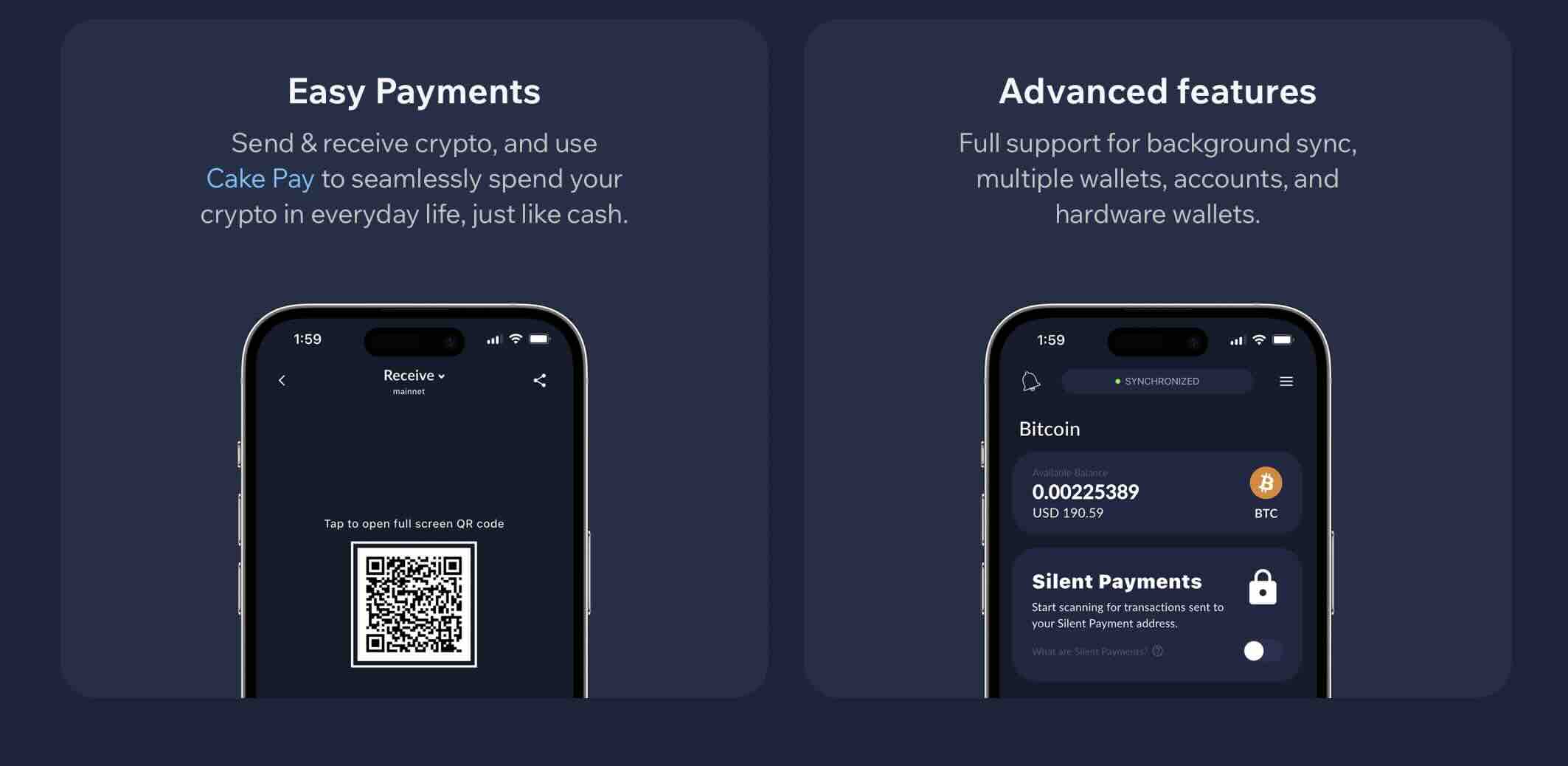
If you care about Bitcoin privacy but don't want to become a command-line wizard, Cake Wallet is your best friend. It's the first fully-featured cryptocurrency wallet to support Bitcoin Silent Payments, one of the largest privacy improvements ever made to the Bitcoin protocol.
This technology allows you to receive Bitcoin without revealing a reusable address, essentially giving you Monero-level receiving privacy on Bitcoin.
Monero Enthusiasts
Cake Wallet has become the dominant player in the Monero ecosystem, reportedly holding about 80% of the Monero wallet market. It offers best-in-class Monero support with features like automatic subaddress generation, node customization, and seamless integration with the XMR network. Users describe it as "hands down the best mobile XMR wallet available," noting it's "simple, reliable, and intuitive" compared to the official desktop GUI.
People Who Actually Want to Use Crypto
Not everyone wants to HODL forever. If you're tired of crypto being treated purely as a speculative asset and actually want to spend it, Cake Wallet has you covered with Cake Pay—a built-in feature that lets you buy gift cards for major retailers (Amazon, Chipotle, SPAR, and 150,000+ other merchants) using Bitcoin, Monero, or other supported cryptocurrencies.
Multi-Currency Users Who Value Control
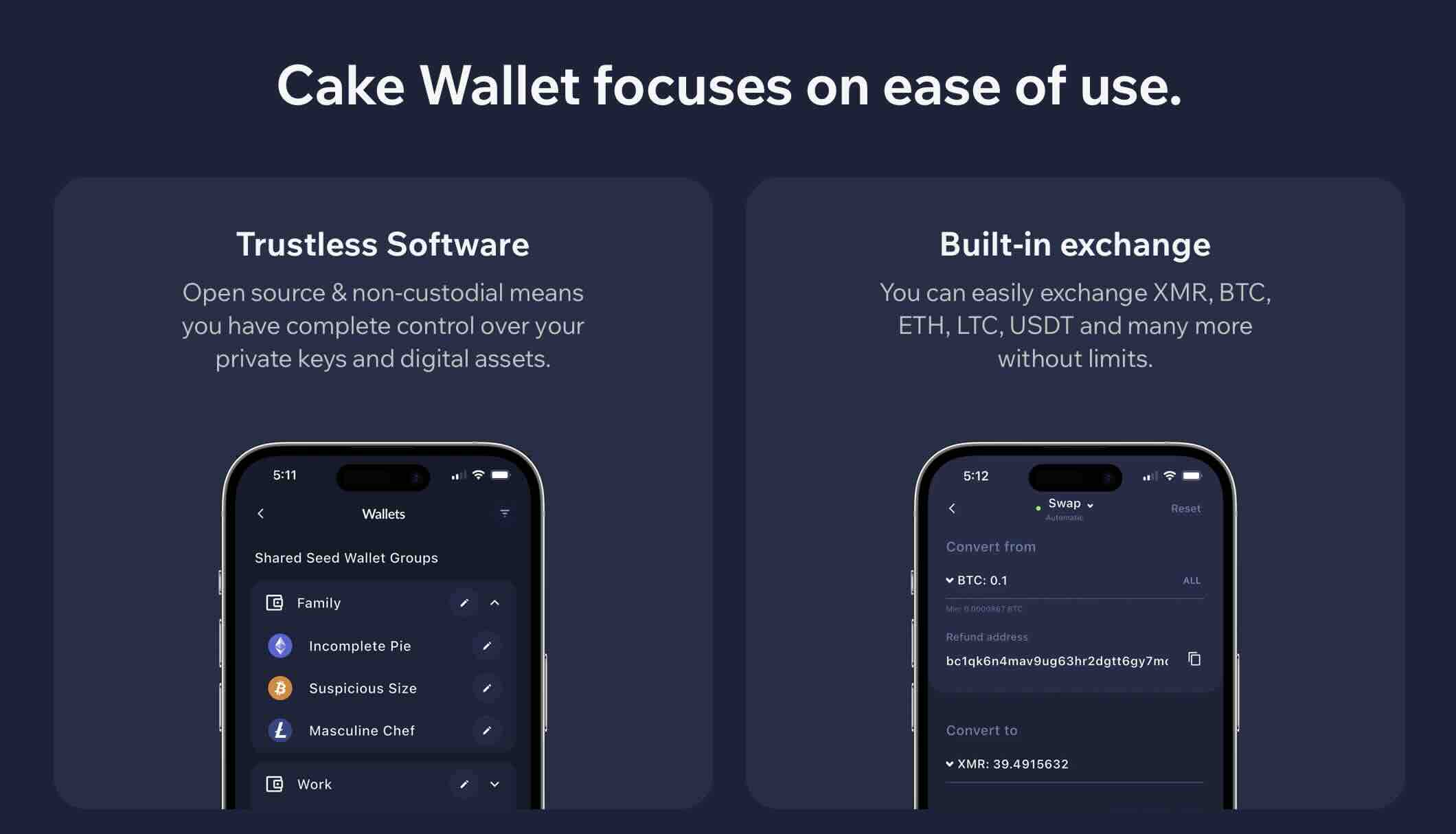
With support for 12+ cryptocurrencies including Bitcoin, Ethereum, Litecoin (with MWEB support), Solana, Polygon, and more, Cake Wallet consolidates your portfolio without sacrificing security. Every coin gets proper wallet-level support, not just token tracking.
What Makes Cake Wallet Different? The Key Advantages
1. Groundbreaking Bitcoin Privacy Tools
Cake Wallet isn't just talking about privacy—it's pioneering it. In May 2025, Cake Wallet became the first major mobile wallet to offer Bitcoin Payjoin v2, introducing a protocol that disrupts blockchain surveillance by mixing transaction inputs from both sender and receiver.
Unlike older privacy solutions that required both parties to be online simultaneously, Cake Wallet's implementation removes this limitation, allowing users to send or receive Bitcoin through asynchronous, serverless PayJoin transactions, no Tor, no apps, no advanced configuration.
Combined with Silent Payments, this gives Cake Wallet users two complementary privacy tools: one for receiving privately, and one for spending privately.
2. True Self-Custody (Not Custodial in Disguise)
Your keys never leave your device. Cake Wallet doesn't have access to your funds, can't freeze your account, and doesn't require KYC to use the core wallet features. This is non-custodial done right, no backdoors, no compromises.
3. Litecoin MWEB Support
Cake Wallet is the first cross-platform wallet to offer MWEB (MimbleWimble Extension Block) support for Litecoin, bringing enhanced privacy and scalability to LTC transactions. If you use Litecoin for its speed and lower fees, you can now do so with significantly better privacy.
4. Native Tor Integration
For network-level privacy, Cake Wallet includes built-in Tor support that doesn't require you to install separate apps or configure complex routing. Just toggle it on, and your connection is masked.
5. Built-In Exchange Without KYC
Need to swap between cryptocurrencies? The wallet features a built-in exchange that lets you easily swap XMR, BTC, ETH, LTC, USDT and many more cryptocurrencies without limits. While exchange rates can sometimes be higher than dedicated platforms, the convenience and privacy of not creating yet another account is often worth it.
6. Hardware Wallet Integration
For those who want an extra security layer, Cake Wallet supports Ledger hardware wallets. This means you can combine the security of Ledger with an open source, privacy-first wallet. Ledger support is available on both iOS (Bluetooth only) and Android for Bitcoin, Ethereum, Litecoin, and other cryptocurrencies.
7. Cupcake: Air-Gapped Security Made Simple
Cake Wallet introduced Cupcake, a companion app that turns an old smartphone into an air-gapped cold storage device, basically a DIY hardware wallet with the same security model as commercial options, but free and fully open-source.
 Cake Labs
8. Cross-Platform Availability
Cake Wallet works on iOS, Android, macOS, Windows, and Linux. Your seed phrase works across all platforms, making it genuinely multi-device without vendor lock-in.
For Miners: What You Need to Know
While Cake Wallet isn't specifically a "mining wallet," it's highly relevant for miners, especially Monero miners. Here's why:
Monero Mining Integration
Monero remains one of the few cryptocurrencies you can still mine profitably on consumer hardware (CPUs). Users note that you can mine Monero with your computer and see how the mining process works in real time , though you shouldn't expect huge returns unless you have high-end hardware.
The beauty of Monero mining through Cake Wallet is that you can mine to your wallet address and maintain complete privacy over your earnings.
The wallet supports connecting to custom Monero nodes, which is essential for miners who run their own nodes to verify transactions and maintain network decentralization.
Bitcoin Mining Payouts
For Bitcoin miners, Cake Wallet's Silent Payment addresses are a game-changer. Instead of reusing the same Bitcoin address for mining pool payouts (which makes it trivial for anyone to see your total mining income), you can give your mining pool a Silent Payment address. Each payout will automatically generate a unique on-chain address that only you can access—protecting your privacy while maintaining the convenience of a single address for the pool.
Privacy for All Mining Operations
Whether you're solo mining, pool mining, or receiving cloud mining payouts, the ability to receive funds without exposing your total balance or transaction history is crucial. Mining operations often involve regular, predictable payments—exactly the kind of pattern that blockchain analysis firms love to track. Cake Wallet's privacy tools make it significantly harder to surveil mining operations.
 Nakamoto Builder
The User Experience: What's It Actually Like?
The Good
Setup is genuinely simple. Download the app, choose your cryptocurrency, write down your seed phrase, and you're done. The interface is clean without being oversimplified—you get access to advanced features when you need them, but they're not shoved in your face.
Background sync is a lifesaver. Unlike some wallets where you have to sit and watch progress bars, Cake Wallet syncs in the background (especially effective on Android), so your balance is always up to date when you open the app.
Support is responsive. Multiple users report getting helpful responses from the support team when issues arise, which is rare in the crypto wallet space.
The Not-So-Good
Sync times can be slow for Monero. This is inherent to how Monero works, not a Cake Wallet problem per se, but first-time users might be frustrated waiting for their wallet to fully sync. The background sync feature mitigates this significantly, but it's still something to be aware of.
Exchange rates aren't always the best. The built-in exchange (powered by third-party partners like ChangeNOW) is convenient, but you're paying for that convenience with slightly higher spreads compared to dedicated exchanges. For large swaps, you might want to use a proper exchange.
iOS has some limitations. Background sync works better on Android than iOS due to Apple's restrictions. iOS users may need to keep the app open longer for syncing.
Learning curve for advanced features. While basic sending and receiving is simple, features like UTXO management, coin control, and Payjoin configuration require some understanding of how Bitcoin works. The wallet could benefit from more in-app tutorials.
Real User Feedback
One long-time user shared: "It always works, and the coins always show up and never go missing. That right there says a lot, considering how many times I've sent, exchanged, and received coins using this app. Anytime I have a question or an issue, the support team has responded quickly and knowledgeably".
Another user praised the self-custody model: "I've been using cake wallet for about 3 or 4 years… I've never lost a transaction… the reason why I say it's the best… is because it 100% is self custody"
The consensus? Cake Wallet is rock-solid for people who understand cryptocurrency basics and value privacy. Negative reviews tend to come from users who made mistakes (wrong address, incorrect recovery phrases) rather than actual wallet failures.
Security: Can You Trust It?
Open-source and auditable. All of Cake Wallet's code is available on GitHub and can be audited in an uncompiled state. This transparency is crucial, you're not trusting a black box.
Non-custodial architecture. Your private keys never leave your device. Even if Cake Wallet's servers were compromised, your funds would remain safe because they never had access to begin with.
No data collection. Unlike many "free" apps that monetize your data, Cake Wallet doesn't require accounts, doesn't log your activity, and doesn't run analytics. Privacy extends beyond just blockchain transactions.
Regular security updates. The development team actively maintains the wallet, fixing bugs and implementing security improvements. The recent updates have focused on strengthening privacy features and improving connection stability.
What's on the Roadmap? (2025 and Beyond)
Cake Wallet's 2025 roadmap includes implementing Bitcoin Lightning with privacy, security, and self-custody in mind—a non-trivial challenge they're close to solving. They're also working on integrating Foundation and Keystone hardware wallet support, revamping the desktop experience, and polishing UI inconsistencies.
The team has also emphasized investments in intuitive coin management, making advanced privacy features like coin control accessible to newcomers without requiring developer-level knowledge.
How Does It Compare to Competitors?
vs. Samourai Wallet: Samourai was known for Bitcoin privacy but faced legal challenges. Cake Wallet offers similar privacy tools (Payjoin, coin control) without the regulatory target on its back, plus multi-currency support.
vs. Wasabi Wallet: Wasabi focuses on Bitcoin-only with CoinJoin. Cake Wallet's approach (Silent Payments + Payjoin) is more accessible and doesn't require coordinator fees or minimum amounts.
vs. Exodus: Exodus has a prettier interface but lacks serious privacy tools and isn't fully open-source. Cake prioritizes function over flash.
vs. Monero GUI: For Monero purists, the official GUI is powerful but clunky. Cake Wallet brings the same functionality with a vastly better mobile experience.
vs. Ledger: Hardware wallet software is inherently more secure, but Cake Wallet can work with Ledger devices while offering better privacy features and multi-currency flexibility.
Pricing: What Does It Cost?
The wallet itself is 100% free. No subscription fees, no premium tiers, no ads. Cake Wallet makes money through small commissions on the built-in exchange and through Cake Pay—but using the core wallet for sending, receiving, and storing is completely free.
You'll pay normal network transaction fees when sending crypto (these go to miners/validators, not to Cake Wallet), and exchange fees if you use the built-in swap feature.
The Bottom Line: Should You Use Cake Wallet?
Cake Wallet is a rare example of a cryptocurrency wallet that doesn't compromise on principles. It's genuinely open-source, actually private, truly non-custodial, and actively pushing the boundaries of what's possible with privacy technology.
You should use Cake Wallet if:
- You care about financial privacy beyond just "number go up"
- You want self-custody without sacrificing usability
- You're a Monero user (it's basically the standard)
- You want cutting-edge Bitcoin privacy features like Silent Payments and Payjoin
- You value open-source software and want to verify what's running on your device
- You're a miner looking to receive payouts privately
- You want multi-currency support without creating 10 different wallets
You might want something else if:
- You only care about price speculation and don't care about privacy (just use an exchange)
- You need the absolute simplest possible interface (though Cake is pretty simple already)
- You're looking for yield farming, staking, or DeFi integrations (Cake is focused on core wallet functionality)
- You're primarily using newer altcoins that Cake doesn't support yet
Final Thoughts
In a space filled with wallets that prioritize flashy interfaces over substance, Cake Wallet stands out by doing the opposite: prioritizing substance while maintaining a clean, functional interface. As CEO Vikrant Sharma puts it: "Bitcoin is open and permissionless, but without privacy, it's a surveillance tool".
Cake Wallet represents what cryptocurrency wallets should be: tools for financial sovereignty that respect your privacy, protect your funds, and don't require you to trust a third party with your money. Whether you're receiving mining payouts, transacting in Monero, or just want to use Bitcoin the way Satoshi intended, privately and permissionlessly, Cake Wallet delivers.
It's not perfect, but it's honest, capable, and constantly improving. For anyone serious about cryptocurrency as a tool for freedom rather than just speculation, Cake Wallet deserves a spot on your device.
Download: Available on iOS, Android, macOS, Windows, and Linux at cakewallet.com
Note: This review is based on the current version of Cake Wallet as of January 2026. Cryptocurrency technology evolves quickly, so always check for the latest features and security updates.
