


Overview
Breez Wallet represents a pioneering effort in making Lightning Network payments truly accessible while maintaining self-custody. As one of the earliest Lightning-native applications, Breez has evolved from a mobile wallet into a comprehensive ecosystem that includes merchant tools, podcasting features, and now, developer infrastructure through the Breez SDK. The wallet strikes an ambitious balance: delivering the simplicity users expect from custodial solutions while preserving the sovereignty that defines Bitcoin's core value proposition.
Unlike competitors that either compromise on custody or sacrifice user experience, Breez tackles Lightning's inherent complexity head-on with innovative technical solutions. The result is a non-custodial wallet that operates seamlessly on mobile devices, manages channels automatically, and provides immediate receiving capacity—achievements that seemed mutually exclusive in Lightning's early days.
Company Origin and Operations
Founding and Leadership
Breez Technology Inc. was founded in 2018 by Roy Sheinfeld, who serves as CEO, alongside two co-founders. Prior to Breez, Sheinfeld co-founded and served as CTO of harmon.ie, an enterprise software company serving over 1,000 customers globally, where he built development teams and led strategic business initiatives with major technology companies including Microsoft, IBM, BlackBerry, and Check Point.
Sheinfeld describes Breez as being founded "just when the first mainnet transactions appeared on the Lightning Network" with the mission "to help transform bitcoin from a store of value to a medium of exchange." This timing positioned Breez as one of the first commercial ventures built on Lightning infrastructure.
Corporate Structure and Funding
Breez is headquartered in Tel Aviv, Israel, operates as a private company with approximately 15 employees, and has assembled a globally distributed team. The company employs developers and contributors from around the world, including Turkey, Croatia, and Ukraine.
As of January 2025, Breez has raised $11 million in total funding across multiple rounds, with the most recent being a $5 million Series B round completed in January 2025. Key investors include Concentric, Plan B VC Fund, Timechain (UK), ego death capital, Hashkey Capital, and Entree Capital.
Strategic Evolution
Breez's strategic evolution reflects the maturation of the Lightning ecosystem itself. The company initially released the first Lightning wallet and became the first Lightning Service Provider (LSP)—a term Sheinfeld himself coined. They also brought the first iteration of podcasting 2.0 to market, enabling users to stream satoshis to podcasters, a model later popularized by platforms like Fountain.
For the past year and a half, the company has shifted focus toward infrastructure development. As Sheinfeld explains, "We think Lightning should be a commodity. Everyone should have the ability to use Lightning if they want to." This philosophy drives their current emphasis on the Breez SDK, which enables any application to integrate Lightning payments with minimal engineering effort.
Business Model
Breez's business model centers on operating as a Lightning Service Provider (LSP), charging fees for specific services. The fee structure includes:
- Routing fees: Approximately 1 satoshi base fee for payments routed through Breez nodes
- Setup fees: Between 2,000 satoshis and 0.4% of the incoming payment amount for channel creation (not charged repeatedly)
- Podcast streaming: Up to 5% commission on satoshis streamed to podcasts through their platform
This model generates revenue while maintaining the wallet's non-custodial nature, allowing Breez to profit from payment routing and liquidity services rather than holding user funds.
Open LSP Model
Breez has pioneered an "Open-LSP Model" that allows third-party LSPs to provide liquidity to wallet users. In 2023, LQwD Fintech became the first third-party Lightning Service Provider integrated with Breez's open model, demonstrating the scalability of this approach. This architecture lets LSPs generate return on their Bitcoin holdings through routing fees without relinquishing custody, creating aligned incentives across the ecosystem.
Why It Exists
The Lightning Network promised to make Bitcoin viable for everyday payments, but early implementations created a paradox: the solution was often more complex than the problem it solved. Self-custodial Lightning wallets required users to:
- Manually open and manage payment channels
- Maintain constant connectivity for reliability
- Fund channels with on-chain transactions
- Understand inbound and outbound liquidity concepts
- Navigate routing failures and force-close scenarios
- Monitor channels for potential cheating attempts
These requirements proved prohibitive for average users, creating a gap between Lightning's theoretical capabilities and practical usability. Custodial solutions emerged to fill this gap but contradicted Bitcoin's fundamental premise of financial sovereignty.
Breez introduced the Lightning Service Provider concept to bridge this divide, where "the channel is initiated and created by the LSP" so users don't need to fund channels themselves, and users benefit from "immediate inbound capacity" allowing them to receive payments instantly once channels are active.
The company recognized that mobile devices—where most people transact—presented unique challenges for running Lightning nodes, including limited battery life, inconsistent connectivity, and restrictive operating system constraints. Solving these problems required fundamental innovations in how Lightning clients operate on smartphones.
What It Does
Core Wallet Functionality
Breez operates as a full-featured, non-custodial Lightning wallet with comprehensive payment capabilities:
👉 Lightning Payments: The wallet handles standard Lightning Network transactions with support for BOLT11 invoices, keysend, LNURL-Pay, and Lightning addresses. All user funds are maintained in Lightning channels, which "simplifies the user experience by obviating many functions of a standard BTC wallet".
👉 Automatic Channel Management: Unlike traditional Lightning wallets requiring manual channel operations, Breez manages all channel lifecycle events automatically. When users need receiving capacity, the wallet handles channel opening seamlessly without user intervention.
👉 Unified Balance Model: Breez uses Submarine Swaps to support on-chain transactions "while maintaining a single balance," meaning users don't need to mentally account for separate on-chain and Lightning balances.
👉 Instant Receiving Capacity: When LSPs fund channels from the outset, users get "immediate inbound capacity" letting them "receive funds immediately via Lightning once the channel is active", eliminating the cold-start problem that plagues other self-custodial solutions.
Point-of-Sale System
Breez includes merchant functionality that transforms the wallet into a Lightning-enabled cash register. Merchants can accept Bitcoin payments through a dedicated point-of-sale interface with customizable settings for business use, including invoice generation, transaction history, and reporting features suitable for retail environments.
Podcasting 2.0 Integration
The wallet incorporates a native podcast player supporting the Value4Value model, where listeners stream satoshis to content creators in real-time. The platform charges a maximum 5% fee on podcast streaming payments, making it economically viable for Breez while keeping costs reasonable for users supporting creators.
Backup and Recovery
Breez offers cloud backup functionality through Google Drive (and iCloud for iOS), storing encrypted wallet data remotely. Users can optionally add an additional encryption layer protected by a 12-word phrase, balancing convenience with security based on individual threat models.
Developer Mode
For technical users, Breez provides direct access to the underlying Lightning node, allowing advanced operations through command-line interfaces and exposing the full capabilities of the LND implementation running under the hood.
Technology Architecture
LND and Neutrino Foundation
Breez is a non-custodial, LND-based wallet that uses the Neutrino protocol to run a local Lightning node on mobile devices. This architectural choice has profound implications:
Lightning Network Daemon (LND): Developed by Lightning Labs, LND is one of the most mature and widely adopted Lightning implementations. Breez runs lnd on Android and iOS, accomplishing the technically challenging feat of operating a full Lightning node on resource-constrained mobile hardware.
Neutrino Protocol: Breez uses Neutrino to fetch chain information, which "provides better privacy than current alternatives" by implementing a lightweight client protocol that downloads compact block filters rather than full blocks. This approach allows the wallet to verify transactions independently without trusting external servers while minimizing bandwidth and storage requirements.
The team has made significant optimizations to make this architecture mobile-friendly:
Breez engineers "retooled Neutrino to allow it to work independently of lnd," reducing code and data competing for CPU resources. They optimized lnd to allow outgoing payments even when the client isn't fully synced, recognizing that sending funds is the primary use case for most users.
The wallet syncs Neutrino "only from the last available mined checkpoint" rather than processing the entire blockchain history each time, dramatically reducing initialization time. Neutrino filters are saved to disk, allowing quick local reference instead of downloading them anew in every instance.
Mobile Operating System Challenges
Running a Lightning node on mobile devices presents unique obstacles that Breez addresses through several mechanisms:
Background tasks on iOS and Android are treated unpredictably, with "CPU access determined by a mystifying combination of battery status, power supply, other concurrently running apps, and proprietary algorithms". Breez schedules regular background tasks to fetch chain data but can't guarantee consistent execution.
As a failsafe, if "Neutrino fails to access the CPU for three days," the app notifies users that it's 72 hours out of sync and needs attention. This wetware backup ensures users know when manual intervention is required to maintain channel security.
Channel Management and Liquidity
The wallet implements sophisticated channel management that operates transparently:
LSPs "act as hubs, providing users with a secure, stable connection to a node that itself is well connected with payment channels to further hubs," ensuring users "can always route payments where they please".
When users receive their first payment, Breez automatically opens a channel funded by their LSP, providing immediate inbound capacity. This channel opening incurs a one-time setup cost of 0.4% with a minimum of 2,000 satoshis, and Breez keeps channels open for at least a month—longer if they remain active.
Submarine Swaps Integration
To bridge the gap between on-chain Bitcoin and Lightning channels, Breez uses Submarine Swaps, which allow the wallet "to support on-chain transactions while maintaining a single balance". This technology enables users to add funds from external on-chain wallets without understanding the technical distinction between layers.
Security Mechanisms
Breez includes a background watcher that "notifies users of cheating attempts even when the app is closed," with a 720-block refund period meaning "users are automatically protected by simply using their phones at least once every 5 days". This watchtower-like functionality provides security without requiring constant connectivity.
Network Graph Management
Lightning routing requires "a map: the network graph," and while nodes typically broadcast channel status every 24 hours, Breez had to adapt this for mobile devices that lack consistent uptime. The wallet implements intelligent graph management that balances freshness with resource constraints.
Breez SDK: Infrastructure Layer
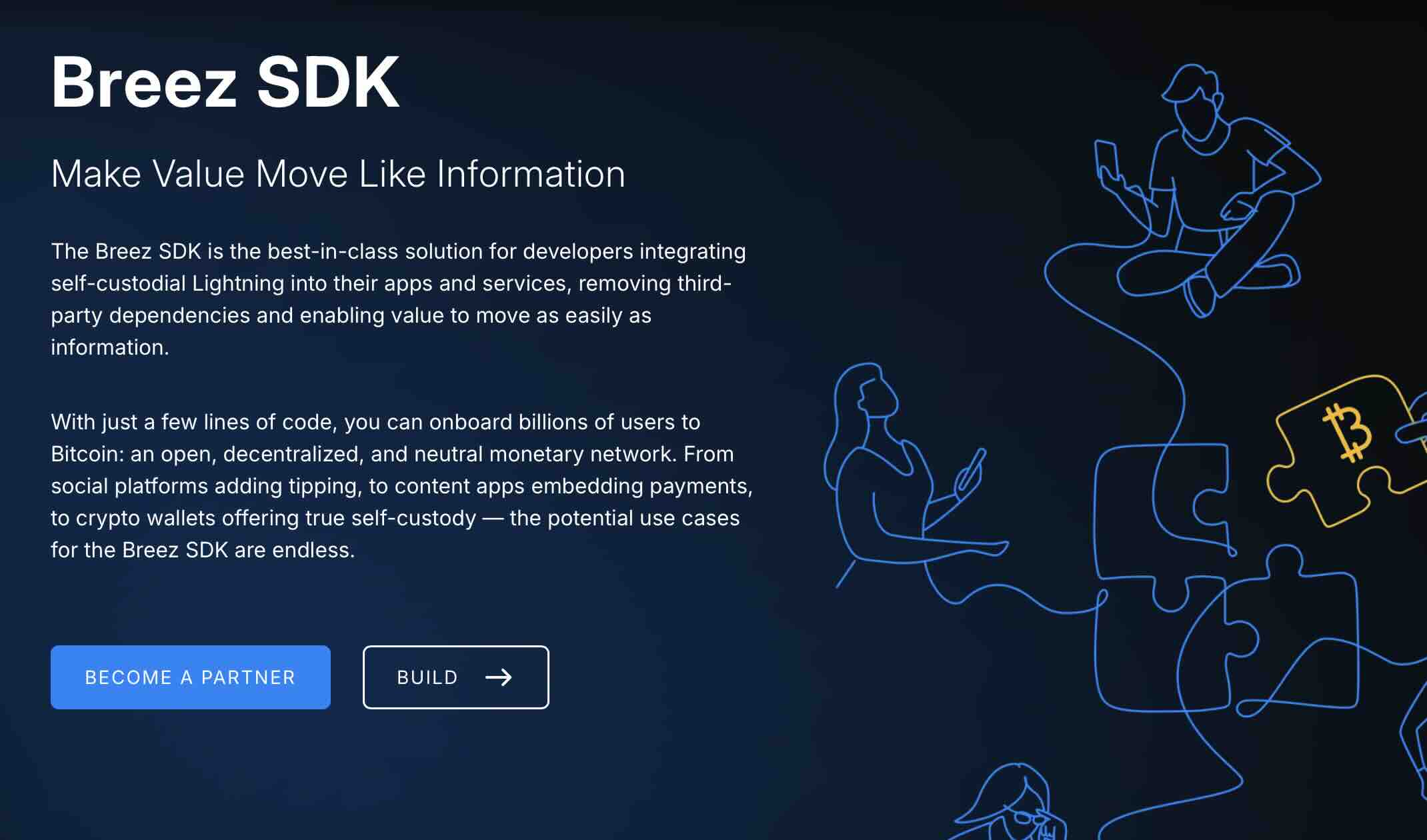
Beyond the consumer wallet, Breez has developed the Breez SDK—a comprehensive toolkit that represents the company's long-term vision.
SDK Architecture Options
The SDK offers two implementation approaches:
Greenlight Implementation: This cloud-based Lightning integration offers a self-custodial solution utilizing "nodes-on-demand provided by Blockstream's Greenlight". The app integrating the SDK runs a validating signer that interacts with end-user nodes, while nodes are hosted on Blockstream's Greenlight cloud infrastructure. Each user maintains their own node, preserving self-custody while outsourcing the operational complexity.
Nodeless Implementation: Built on Liquid sidechain technology, this approach provides Lightning functionality without requiring traditional Lightning channels, offering a different set of trade-offs suitable for specific use cases.
SDK Capabilities
The Breez SDK provides developers with end-to-end Lightning integration including:
- Sending payments via multiple protocols (BOLT11, LNURL-Pay, Lightning addresses, BTC addresses)
- Receiving payments with automatic liquidity management
- Built-in LSP integration
- On-chain interoperability through Submarine Swaps
- Third-party fiat on-ramp connections
- Notification infrastructure for payment events
The SDK is free for developers, requiring only an API key and invite code to begin implementation. This accessibility has enabled dozens of projects to integrate Lightning functionality without building infrastructure from scratch.
Real-World Implementations
Several production applications now leverage the Breez SDK:
- Volt (Nigeria): Bringing Lightning payments to African markets
- Yopaki (Mexico): A neobank with Bitcoin focus serving Latin American users
- Flash (Caribbean): Addressing the region's financial infrastructure challenges
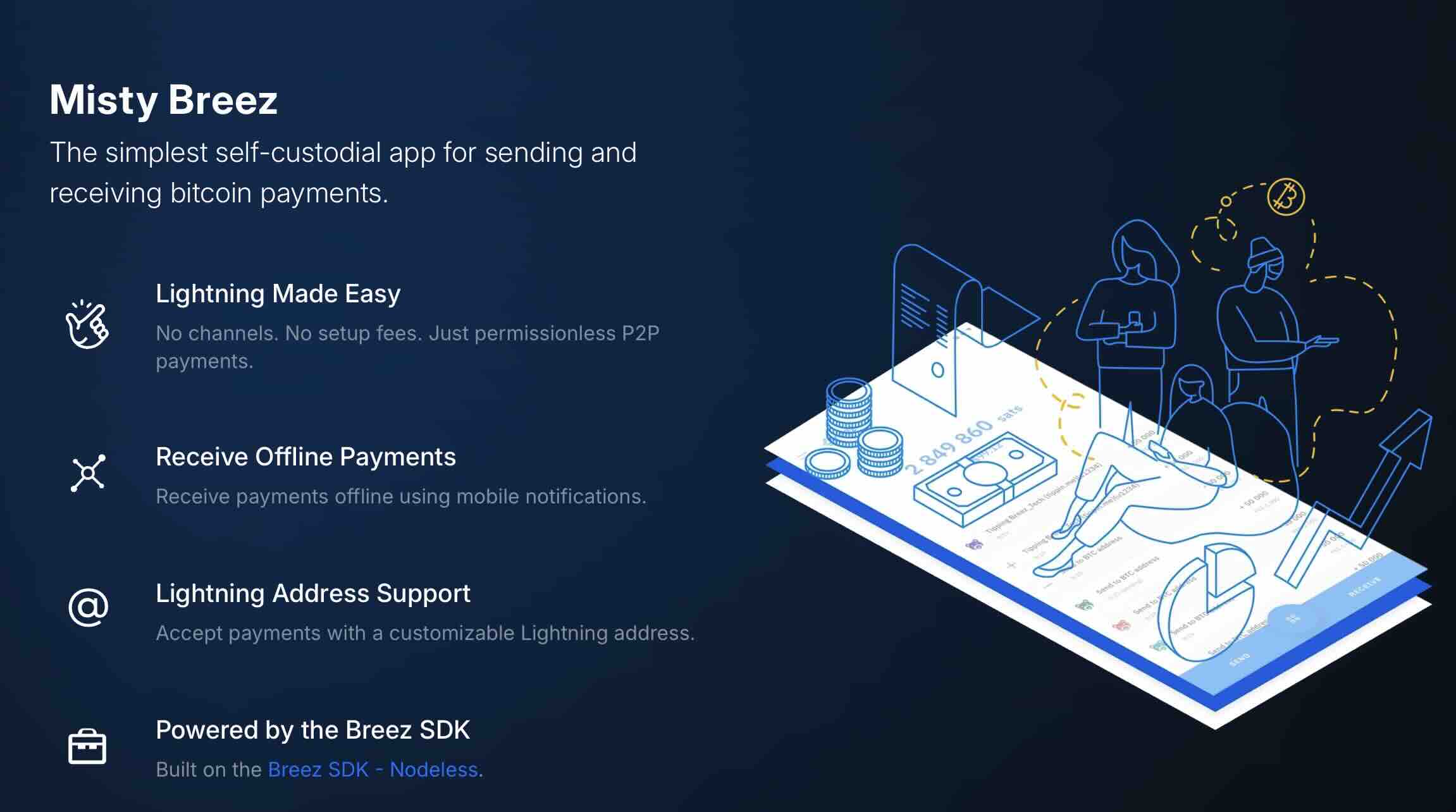
- Misty Breez: Breez's own reference implementation showcasing SDK capabilities
Who It's For
Technical Enthusiasts Seeking Sovereignty
Breez appeals to users who understand Bitcoin's "not your keys, not your coins" ethos but want Lightning functionality without managing node infrastructure manually. These users appreciate being able to inspect the underlying LND operations while trusting Breez to handle routine channel management.
Merchants and Business Operators
The integrated point-of-sale functionality makes Breez practical for brick-and-mortar businesses accepting Lightning payments. Merchants gain immediate access to Lightning's low fees and instant settlement without purchasing dedicated hardware or maintaining separate systems.
Content Creators and Podcasters
The Value4Value model built into Breez provides creators with direct monetization through satoshi streaming. Podcasters can receive micropayments in real-time without intermediaries, subscription fees, or advertising dependencies.
Mobile-First Users
For users whose primary computing device is a smartphone, Breez offers full Lightning functionality without requiring desktop infrastructure or always-on servers. The wallet handles the technical challenges of mobile Lightning node operation transparently.
Developers Building on Lightning
Through the Breez SDK, developers can integrate sophisticated Lightning functionality into their applications without becoming Lightning experts themselves. This is particularly valuable for teams building financial services, payment applications, or Bitcoin-enabled platforms.
Privacy-Conscious Users
The Neutrino implementation provides better privacy than many alternatives by allowing users to verify transactions independently. Users can even connect to their own Bitcoin nodes via the Preferences > Network screen for maximum sovereignty.
Who It's Not For
Absolute Beginners
Despite efforts at simplification, Breez's self-custodial nature means it's more complex than custodial alternatives like Wallet of Satoshi. New Bitcoin users might find the backup requirements, channel concepts, and occasional need for on-chain transactions confusing.
Users Prioritizing Simplicity Above All
If immediate functionality without any learning curve is the priority, custodial solutions offer faster onboarding. Breez requires understanding concepts like inbound capacity, backup procedures, and channel fees—even if the wallet automates most operations.
Large-Value Storage
Like all hot wallets, Breez is designed for spending, not long-term storage of significant amounts. Users should maintain meaningful holdings in cold storage solutions with Breez serving as their day-to-day spending wallet.
Users Without Regular Mobile Access
The requirement to use the phone at least once every five days for security monitoring makes Breez impractical for users who regularly go offline for extended periods or prefer desktop-only solutions.
Those Seeking Maximum Routing Privacy
While Neutrino provides good privacy, users seeking maximum anonymity might prefer solutions with additional privacy layers or Tor integration. The LSP model also means Breez nodes have visibility into user payment activity.
Strengths
Pioneering Self-Custodial Mobile Lightning: Breez solved technical problems that seemed insurmountable, running a full Lightning node on mobile devices years before it became common. This achievement laid groundwork for the entire self-custodial mobile Lightning category.
Automatic Channel Management: Users gain self-custody benefits without channel management complexity. The wallet handles opening, closing, and rebalancing automatically, abstracting away Lightning's most challenging aspects.
Immediate Receiving Capacity: The LSP model eliminates the cold-start problem, allowing new users to receive payments immediately instead of first spending to create inbound liquidity.
Comprehensive Feature Set: Beyond basic payments, Breez integrates merchant tools, podcasting functionality, and developer access, making it a platform rather than just a wallet.
Technical Innovation: From coining the LSP term to optimizing Neutrino for mobile, Breez has consistently pushed Lightning technology forward, often creating solutions that benefit the entire ecosystem.
True Self-Custody: Unlike hybrid approaches that compromise on sovereignty, Breez maintains genuine self-custody with users controlling their keys while the wallet manages operational complexity.
Open-Source Commitment: All Breez code is FOSS (free and open-source software), allowing community review, contribution, and trust verification.
SDK Ecosystem: The Breez SDK enables other developers to build Lightning-enabled applications without duplicating infrastructure work, potentially accelerating Lightning adoption across diverse use cases.
Active Development: Regular updates demonstrate ongoing commitment, with the company continuously improving both the consumer wallet and developer tools.
Flexible Backup Options: The cloud backup with optional encryption layers allows users to choose their preferred security-convenience balance.
Limitations
Onboarding Complexity: New users face setup costs (2,000 sats minimum), backup procedures, and conceptual learning that exceeds custodial alternatives. The first-time experience, while streamlined, still requires more steps than competitors.
Initial Costs: The channel setup fee, while reasonable, creates a barrier for users wanting to experiment with tiny amounts. The 2,000 satoshi minimum and 0.4% fee can feel significant for first-time Lightning users.
Mobile-Only Focus: The lack of desktop applications or web interfaces limits usability for users who prefer multi-device access or need desktop-based workflows.
Dependency on LSPs: While self-custodial, users depend on Breez or partner LSPs for channel services. If these services become unavailable or change terms, user experience degrades.
Cloud Backup Trade-offs: Google Drive or iCloud backup storage requires trust in these platforms despite encryption. Users skeptical of cloud storage must implement alternative backup strategies.
Sync Requirements: The need to open the app periodically for security monitoring creates an ongoing user responsibility that custodial solutions don't require.
Learning Curve for Advanced Features: While basic payments work simply, understanding channel states, submarine swaps, and routing requires technical knowledge that many users lack.
Fee Structure Transparency: The various fees (routing, setup, podcast streaming) can confuse users accustomed to traditional Bitcoin's straightforward transaction fee model.
Limited Fiat Integration: Unlike some competitors, Breez doesn't provide direct fiat on-ramps, requiring users to acquire Bitcoin elsewhere before using the wallet.
Comparison with Alternatives
vs. Phoenix Wallet
Phoenix offers similar self-custodial Lightning with automated channel management but uses Acinq's proprietary Eclair implementation. Phoenix provides arguably simpler onboarding with automatic splicing and a cleaner single-channel design. However, Breez offers more features (POS, podcasting) and the ability to run multiple channels. Choose Phoenix for maximum simplicity in a pure payment wallet; choose Breez for a feature-rich platform.
vs. Wallet of Satoshi
Wallet of Satoshi delivers unmatched simplicity through full custody, with zero setup costs or channel concepts. It wins on pure ease of use but contradicts Bitcoin's self-custody principles. Breez requires more learning and initial costs but preserves sovereignty. Use Wallet of Satoshi for onboarding absolute beginners or temporary spending; use Breez when self-custody matters.
vs. Zeus
Zeus offers powerful node management for users running their own Lightning infrastructure (LND, Core Lightning, Eclair). It's far more technical than Breez, requiring users to maintain their own backend nodes. Zeus provides maximum control and flexibility; Breez provides an integrated solution. Choose Zeus if you already run Lightning infrastructure; choose Breez for an all-in-one mobile solution.
vs. Muun Wallet
Muun provides self-custody with unified Bitcoin/Lightning functionality but uses a unique architecture that can result in higher fees, especially for Lightning transactions. Breez offers pure Lightning with better economics for frequent small payments. Muun better serves users who primarily transact on-chain with occasional Lightning use; Breez better serves Lightning-focused users.
vs. BlueWallet
BlueWallet offers both custodial Lightning and self-custodial on-chain in a single app but requires connecting to external Lightning nodes (LNDHub) for self-custodial Lightning. Breez integrates everything, running a full Lightning node internally. BlueWallet provides more flexibility in deployment models; Breez provides a more cohesive experience.
vs. Cash App
Cash App offers Bitcoin integration with strong fiat connectivity but as a fully custodial service requiring identity verification. It provides mainstream accessibility that Breez can't match but at the cost of privacy, sovereignty, and Lightning access. Cash App serves users prioritizing fiat integration; Breez serves users prioritizing Bitcoin functionality.
Role in the Bitcoin Ecosystem
Lightning Innovation Driver: Breez has consistently pioneered solutions to Lightning's hardest problems, from mobile node operation to the LSP model, creating standards others follow.
Self-Custody Bridge: The wallet proves that sophisticated Lightning functionality and self-custody can coexist, challenging the assumption that users must choose between sovereignty and usability.
Developer Infrastructure: Through the Breez SDK, the company enables other builders to integrate Lightning without mastering its complexity, potentially accelerating adoption across diverse applications.
Merchant Gateway: The integrated POS functionality provides small businesses with accessible Lightning acceptance without dedicated hardware or technical expertise.
Value4Value Pioneer: Early podcasting integration helped establish the Value4Value model, demonstrating Lightning's viability for content monetization beyond traditional payment use cases.
Open-Source Contributor: Breez's commitment to FOSS strengthens the Lightning ecosystem by making their innovations available for others to learn from, audit, and build upon.
LSP Market Creator: By establishing and opening the LSP model, Breez created a new market sector where third parties can profitably provide Lightning liquidity services, distributing infrastructure away from centralized providers.
What It Costs
The wallet is free. No subscription, no account fees, no premium tiers.
Channel setup: 2,000 sats minimum (around $2), or 0.4% of your first incoming payment, whichever is larger. This is one-time, not recurring.
Routing: About 1 sat per payment. Essentially free.
Podcasting: 5% of satoshis you stream to creators.
SDK: Free for developers.
No hidden costs, no surprises. Thank you Breez 😄
Editorial Verdict
Breez Wallet occupies a unique position in the Lightning ecosystem: it delivers genuine self-custody while approaching the usability of custodial solutions. This achievement required years of technical innovation, from optimizing mobile Lightning nodes to creating the LSP model that revolutionized channel management.
For users who value sovereignty but lack technical expertise to run full Lightning infrastructure, Breez provides an ideal middle ground. The wallet manages complexity without assuming custody, automates channel operations without hiding what's happening, and provides advanced features without cluttering the core experience.
The company's evolution from a consumer wallet to an infrastructure provider through the Breez SDK represents strategic maturity. Rather than competing solely in the crowded wallet market, Breez now enables countless other applications to integrate Lightning functionality, potentially multiplying their impact on Lightning adoption.
The technical achievements deserve recognition. Running a full Lightning node on mobile devices, implementing automatic channel management while preserving self-custody, and solving Neutrino's mobile challenges represent genuine innovations that benefit the entire ecosystem. These weren't obvious engineering tasks—they required deep protocol understanding and creative problem-solving.
Looking forward, Breez's SDK strategy seems prescient. As Lightning matures, the winner likely won't be the best standalone wallet but rather the infrastructure enabling Lightning everywhere. By positioning as the go-to solution for developers adding Lightning to existing applications, Breez potentially captures more long-term value than wallet-only approaches.
—Disclosure
This review was written independently and The analysis draws from publicly available information, technical documentation, and assessment of the wallet's role within the broader Bitcoin and Lightning Network ecosystem. Users should conduct their own research, evaluate their specific needs and risk tolerance, and understand that self-custodial solutions require ongoing responsibility for backup management and security practices.
